
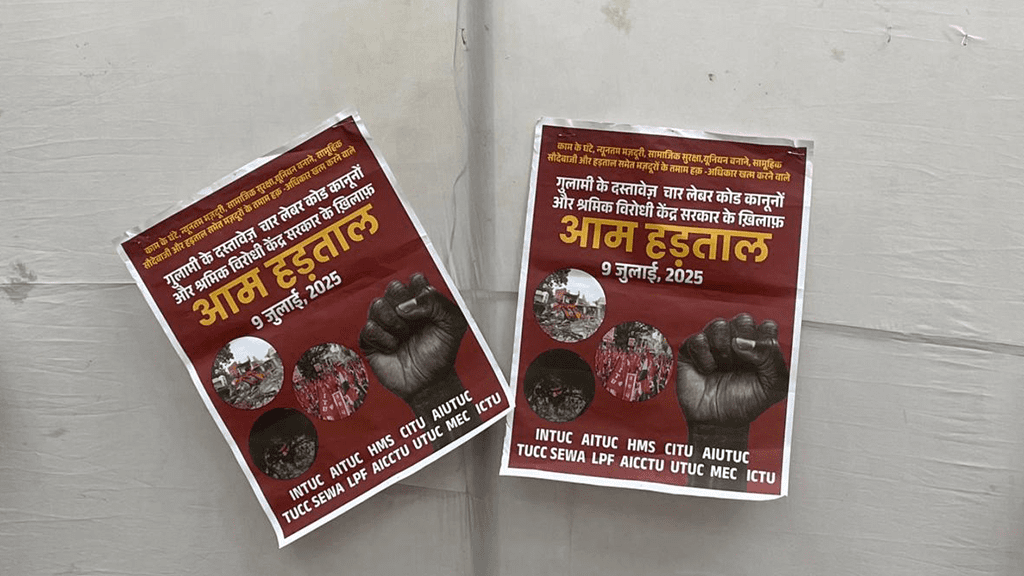
On July 9, 2025, thousands of workers, supported by ten central trade unions and their affiliates, participated in a Bharat Bandh (nationwide strike) to protest against what they described as the government’s anti-worker, anti-farmer, and pro-corporate policies. The strike was called by central trade unions including the All India Trade Union Congress (AITUC), Indian National Trade Union Congress (INTUC), Centre of Indian Trade Unions (CITU), Hind Mazdoor Sabha (HMS), Self Employed Women’s Association (SEWA), and others, and it was backed by several farmers’ organizations.
According to union estimates, over 25 crore (250 million) workers participated in the strike. Sectors affected included banking, insurance, postal services, mining, and construction, among others. Protesters raised concerns over the four new labour codes—on wages, industrial relations, social security, and occupational health and safety—along with issues like privatization, contract work, inflation, and job insecurity. Union leaders argued that these policies are eroding job and wage security.
Non-Participation in Bharat Bandh by Key Unions Against Four Labour Codes
However, not all unions joined the protest. A total of 213 unions, including the Bharatiya Mazdoor Sangh (BMS)—affiliated with the RSS—and its affiliate, the Government Employees National Confederation (GENC), opted out of the strike. In Tamil Nadu, the Anna Trade Union, linked to the AIADMK political party, also chose not to participate. Major banking unions such as the All India Bank Officers’ Confederation (AIBOC), All India Bank Employees Association (AIBEA), and the Bank Employees Federation of India (BEFI) also stayed away from the bandh.
Why Was the Bharat Bandh Called?
The striking unions submitted 17 demands to Union Labour and Employment Minister Mansukh Mandaviya. Their key demands included:
- Scrapping the four new labour codes.
- Halting the privatization of public sector enterprises.
- Restoring basic workers’ rights, such as forming unions, the right to strike, and collective bargaining.
- Filling government job vacancies and increasing public sector employment.
- Strengthening and expanding welfare schemes like MGNREGA.
The strike underscores a broader debate over the direction of economic reforms in India. While the government argues that the new labour laws aim to simplify and modernize outdated regulations to attract investment and create jobs, trade unions view the changes as skewed in favor of large corporations, often at the cost of workers’ rights and social security.
