
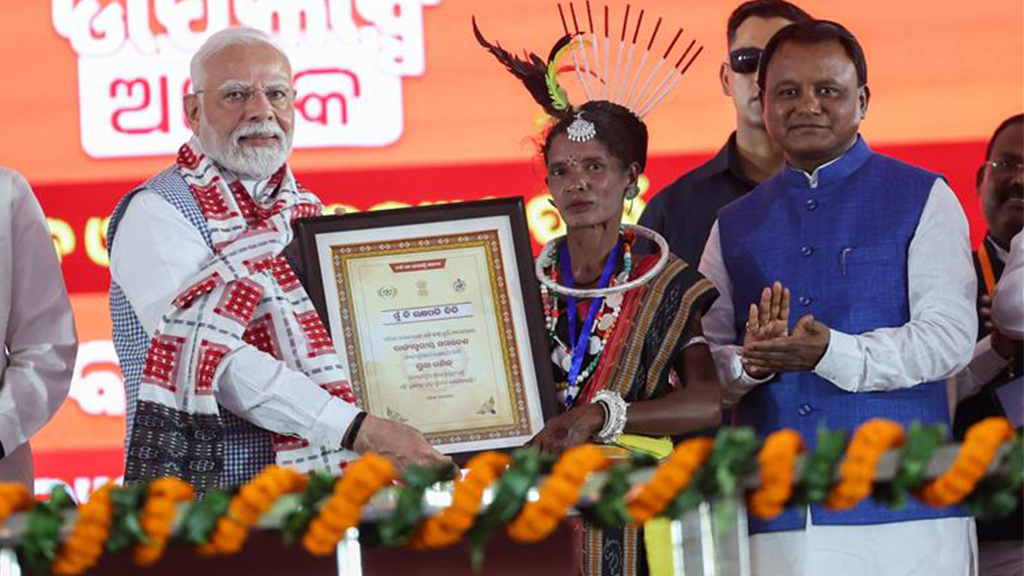
On June 20, Prime Minister Narendra Modi visited Bhubaneswar, the capital city of Odisha, to mark one year of Bharatiya Janata Party (BJP) rule in the state. Addressing a large gathering at Janata Maidan, Modi lauded the “good governance” brought forth by his party. With waving saffron flags and chants of development, the event painted a grand picture of progress. Yet, beneath the spectacle, questions remain about the nature of this transformation. The past year has signaled not just administrative change but a deeper ideological shift—one that appears less inclusive, more centralised, and increasingly defined by the politics of power and image, rather than that of participation.
A year into its term in Odisha, the BJP has fallen short of the big promises it made during the elections. One such promise of the Majhi government to the farmers was that their paddy would be procured by the government at a hiked Minimum Support Price (MSP) rate of Rs. 3100 per quintal and they would be paid within 48 hours of the procurement. However, the government has failed to uphold this promise, as the farmers continue to face a deduction of 8–15 kg per quintal during the procurement itself under the ‘katni chhatni’ system, which the government had also promised would be removed. Moreover, as claimed by Odisha Pradesh Congress Committee (OPCC) President Bhakta Charan Das, 344 farmers of Raigarh, who sold 14,000 quintals of paddy four months ago, still remain unpaid.
Additionally, the government had promised 300 units of free electricity under the PM-Surya Ghar Yojana. But no announcement of the same has been made since.
BJP’s Saffronisation of Odisha Public Spaces
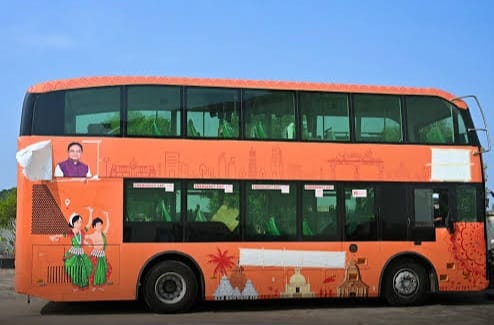
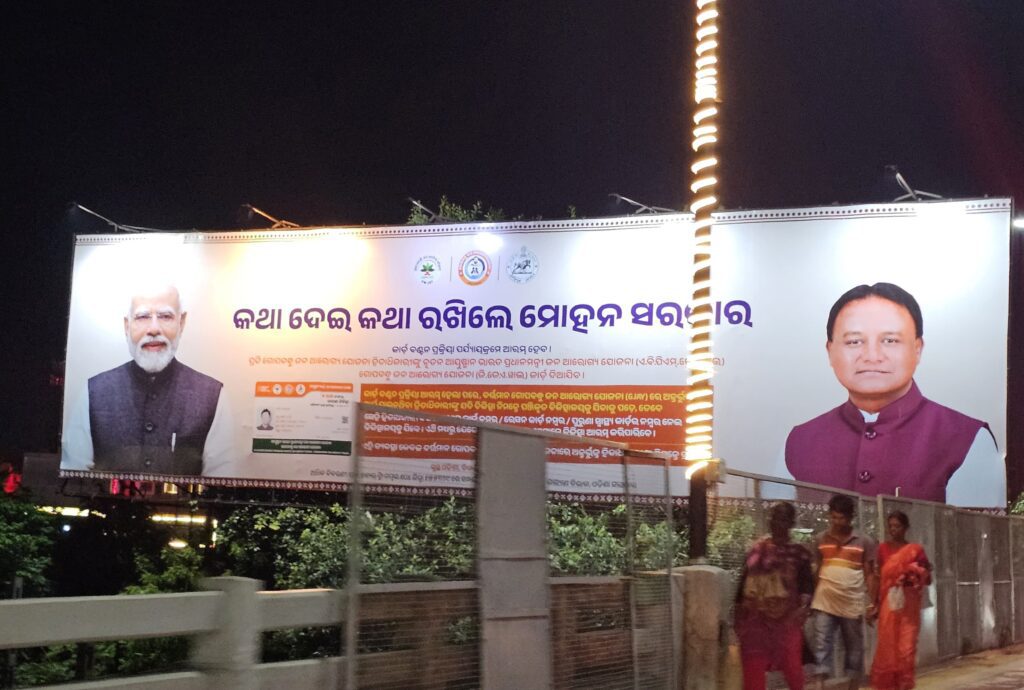
Since assuming power, the BJP government in Odisha has set out on a symbolic yet belligerent campaign of saffronisation. Public infrastructure in Bhubaneswar, such as buildings, bridges, and buses, has gradually been repainted in shades of saffron—the color long connected with the party’s ideological identity. One such instance is the renaming of the widely used ‘Mo Bus’ public transport service, a flagship initiative under the erstwhile Biju Janata Dal (BJD) government, to ‘Ama Bus.’ The newly introduced saffron double-decker and hop-on hop-off buses now serve not only as public transport but also as mobile propaganda vehicles, with pictures of Chief Minister Mohan Majhi and PM Modi over them. A public bus, in essence, has been repurposed as a PR machine, blurring the lines between public utility and political promotion. Similarly, the Buxi Jagabandhu Bidyadhar (BJB) college, which was earlier pink and white, has also been repainted saffron right before their National Assessment and Accreditation Council (NAAC) visit. One can also notice the increasing number of billboards advertising the BJP. According to reports, an estimated Rs. 1,000–1,500 crore has been spent on the party’s rebranding alone. This indicates how the party has focused heavily on its political image and campaigning in a state where it formed its government for the first time.
A Strategic Reorientation of Political Geography
Odisha, particularly Bhubaneswar, has quickly come to top the BJP’s list of choice locations for big-ticket events. The capital previously hosted the Prabasi Bharatiya Divas in January, indicative of a concerted attempt to boost the party’s standing in Eastern India. Modi’s latest visit can also be seen as part of this larger political calculus. In his speech, he claimed to have turned down an invitation from U.S. President Donald Trump to visit Washington D.C., choosing instead to visit “the land of Lord Jagannath.” Prioritizing domestic visits should be standard for any head of government, not glorified as acts of nationalistic sacrifice. If symbolic gestures hold such weight, why has there been no visit to Manipur, a state still bleeding from prolonged ethnic violence, displacement, and humanitarian crisis? Selective visits reflect not merely logistical choices but political priorities, often revealing an uncomfortable truth—optics and electoral calculations frequently overlook a lack of effective governance and the prevalence of human suffering.
Development or Displacement?
Modi also boasts of naxalism having been significantly curtailed in the state and that their government is committed to safeguarding Adivasi communities. But this is belied by the context of stepped-up extractive activities in tribal belts, increased privatisation of natural resources, and the push to turn Odisha into a petrochemical and industrial hub. What is presented as economic progress here translates to the dispossession of indigenous communities, environmental degradation, and increased state surveillance in resource-rich regions. Villages in the Koraput district, mostly consisting of tribal populations, protested against the allotment of the Balada Bauxite mining project to a subsidiary of the Adani group, which acquired leases for the project in reserve forest areas without the consent of the Gram Sabhas, stripping people of agency and autonomy over their own land, which is critical for a participatory democracy. There is a need to look at these activities as part of the larger neoliberal extractive project of mining across states (e.g., Bastar, Hasdeo Aranya, Gadchiroli, Sijimali), the rise of local anti-mining movements by Adivasis of the respective regions, and the subsequent state repression that is ongoing.
As the BJP completes one year in office, it is evident that the communal rhetoric it used to mobilize people to come into power in the state has not only persisted but has also been gradually institutionalized through ideological branding of public spaces and a development model that prioritizes industry over people. The party’s emphasis on the so-called benefits of a “double-engine government” also sends a strong message that the Centre will favor states that are politically aligned with it. This model of conditional governance leaves non-BJP states struggling for attention and resources, further eroding the spirit of federalism. The next four years will determine whether Odisha turns into a laboratory for Hindutva politics and neoliberal economics or a counter-force from regional parties and civil society.
This is an opinion piece by Himangi Patnaik and Omjyoti Mahapatra
