
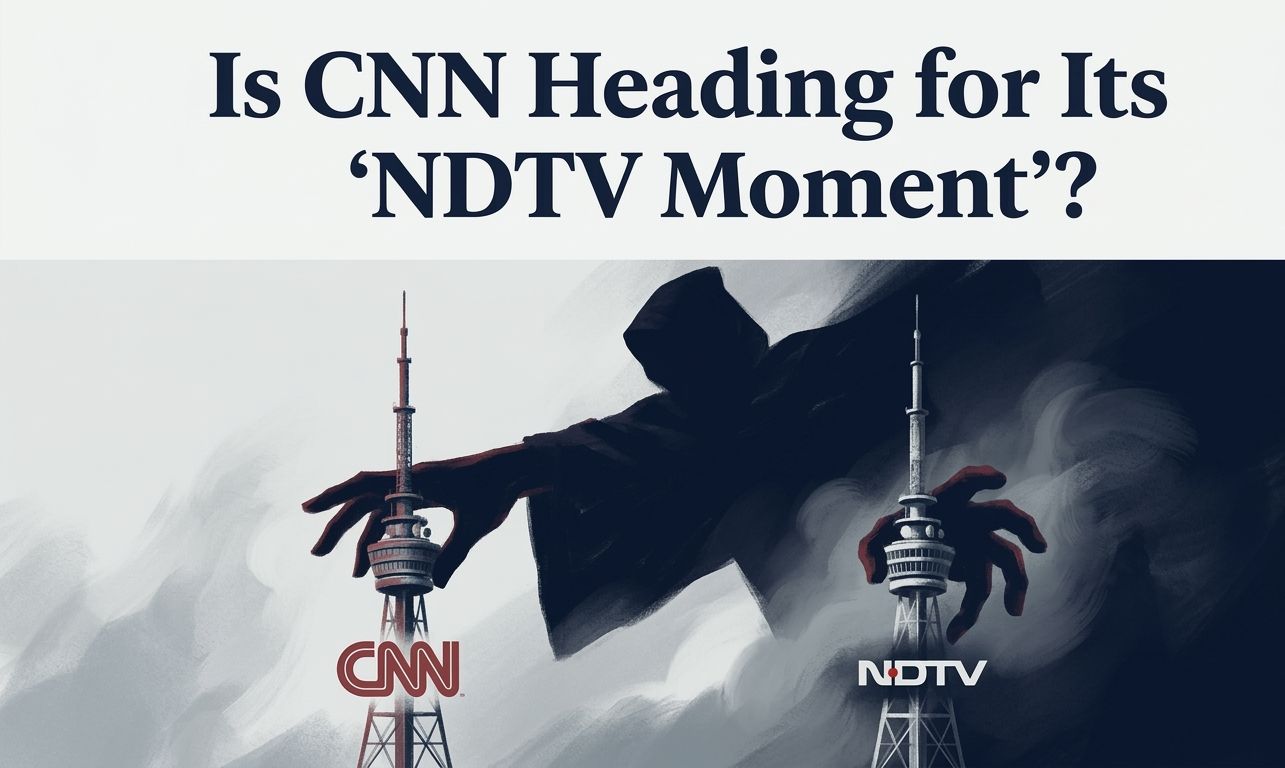
From Washington to New Delhi, the struggle between power and journalism is increasingly being fought inside the newsroom itself.
The relationship between governments and independent journalism has always been uneasy. Democracies celebrate the idea of a free press, yet political power has rarely been comfortable with scrutiny. The tension is built into the system. Journalism asks questions; governments prefer control of the narrative. The balance between the two is never perfectly stable.
That familiar friction has resurfaced in the United States. In recent weeks, criticism from figures aligned with the political orbit of Donald Trump has focused sharply on CNN’s coverage of global conflicts and American military strategy. The complaint is straightforward. According to these critics, the network is highlighting American vulnerabilities and airing analysis that could weaken national resolve. In moments of geopolitical tension, they argue, the media should project unity rather than uncertainty.
This argument is not new. It has appeared in various forms throughout modern history whenever wars or strategic crises dominate the public conversation. During conflict, governments often prefer journalism that reinforces national confidence. Independent reporting, by contrast, tends to reveal complexity. It highlights doubts, disagreements and sometimes uncomfortable truths.
Recent remarks by Trump-aligned commentators, including television personality and political figure Pete Hegseth, have reflected this frustration with what they see as overly critical or insufficiently patriotic coverage. The implication behind such criticism is clear. When the nation is engaged in geopolitical rivalry, journalists should think carefully before emphasising strategic weaknesses or internal debates.
For journalists, that proposition raises a difficult question. Who determines the boundary between responsible reporting and patriotic silence?
If the answer rests solely with political authority, the role of the press changes fundamentally. A newsroom that prioritises patriotic messaging over independent scrutiny risks becoming an amplifier of state narratives rather than a monitor of power. Democratic societies have traditionally resisted that model, at least in principle, because journalism exists not to reassure governments but to inform citizens.
Yet the pressure to align media coverage with national narratives tends to intensify during moments of international tension. War and geopolitical rivalry heighten the sensitivity of governments to public perception. Information itself becomes part of strategy. Narratives acquire political value.
Behind the immediate controversy surrounding CNN lies another, quieter dimension. Modern journalism operates within vast corporate structures. CNN is not simply a newsroom; it is part of a global media conglomerate. Its parent company, Warner Bros. Discovery, emerged from one of the largest mergers in the entertainment and broadcasting industry.
That corporate environment matters.
Across the world, the economics of media are undergoing profound change. Traditional television networks face declining viewership, competition from digital platforms and relentless financial pressure. Consolidation has become a defining feature of the industry. Media companies merge, restructure and seek new investors in an effort to remain competitive.
In such a landscape, editorial independence often intersects with corporate realities. Ownership structures shape newsroom cultures in subtle but powerful ways. Even the perception of political or commercial influence can alter how audiences interpret the news they consume.
This is where the comparison with India becomes relevant.
A few years ago, one of India’s most prominent English-language news networks, NDTV, found itself at the centre of a similar debate. The channel was acquired by the Adani Group following an open offer triggered by the purchase of a financial stake that had long existed within the company’s ownership structure. Legally, the acquisition followed established market rules. Yet politically and symbolically, it triggered a wider national conversation.
For decades, NDTV had cultivated a reputation for independent reporting and editorial autonomy. Its critics accused it of ideological bias. Its supporters saw it as one of the few mainstream broadcasters willing to question authority. When ownership shifted to one of India’s largest business conglomerates, a conglomerate often described by critics as having close ties to the political establishment, the future of the newsroom inevitably became a subject of public scrutiny.
Supporters of the acquisition argued that ownership changes are a routine part of corporate life. News organisations are businesses as well as public institutions. Investors buy and sell media assets just as they do companies in any other sector.
Sceptics viewed the development differently. They wondered whether editorial independence could remain fully intact when the ownership structure of a news organisation becomes closely linked, directly or indirectly, to centres of political or economic power.
The phrase “NDTV moment” gradually entered media discussions as shorthand for this broader dilemma: the intersection of corporate ownership, political proximity and newsroom autonomy.
Viewed through that lens, the debate surrounding CNN appears less like an isolated American controversy and more like part of a global pattern.
Across political systems, governments tend to react sharply when journalism highlights national weaknesses during periods of strategic tension. In such moments, power prefers unity. Journalism, by its nature, prefers inquiry. The two instincts frequently collide.
The pressure on media institutions does not always arrive in dramatic form. Sometimes it appears as public criticism of reporters. Sometimes through regulatory scrutiny or political messaging. In other cases, the pressure emerges indirectly through market dynamics, investment structures or corporate realignment.
The mechanisms vary from country to country. The underlying tension remains strikingly similar.
For democracies, this tension is not merely institutional; it is philosophical. A democratic system depends on informed citizens. Informed citizens depend on credible information. Credible information requires journalists who are willing to report not only triumphs but also uncertainties, disagreements and vulnerabilities.
War coverage makes this responsibility particularly complex. Military operations involve secrecy, strategy and national pride. Governments often argue that certain information must remain confidential for security reasons. Journalists argue that public accountability cannot vanish entirely during conflict.
The line between responsible restraint and narrative management is rarely clear. Yet the distinction matters. If journalism gradually shifts from scrutiny to affirmation, the public conversation begins to narrow. Citizens receive reassurance rather than analysis. Narratives replace facts.
History offers numerous examples of how dangerous that shift can become.
The deeper question raised by the current CNN debate, therefore, is not about one television network or one political figure. It concerns the fragile boundary between journalism and power.
Modern media ecosystems are complex. Newsrooms operate within corporate structures. Governments interact with media through regulation, messaging and sometimes confrontation. These relationships are not inherently problematic. Democracies function through constant negotiation between institutions.
The danger arises when the lines between these spheres begin to blur.
A newsroom cannot serve two masters indefinitely. It cannot simultaneously function as an independent observer and a loyal instrument of power. At some point, consciously or otherwise, it must decide which role defines its purpose.
That is why the metaphor of an “NDTV moment” resonates beyond India. It captures a broader global anxiety about the future of independent journalism in an age when political authority, corporate capital and media influence increasingly intersect.
Sometimes the impact of such intersections is immediate. Sometimes it unfolds slowly, through subtle changes in editorial tone and institutional culture. And sometimes the debate itself becomes part of the story.
For readers and viewers, the most important task is simply to remain attentive. Media institutions shape how societies understand war, diplomacy and political power. When the pressures surrounding those institutions intensify, citizens should ask careful questions.
Not about loyalty.
Not about ideology.
About independence.
Because in the end, the strength of a democracy can often be measured by a simple test: how comfortable those in power remain when journalists continue to report the truth.
