
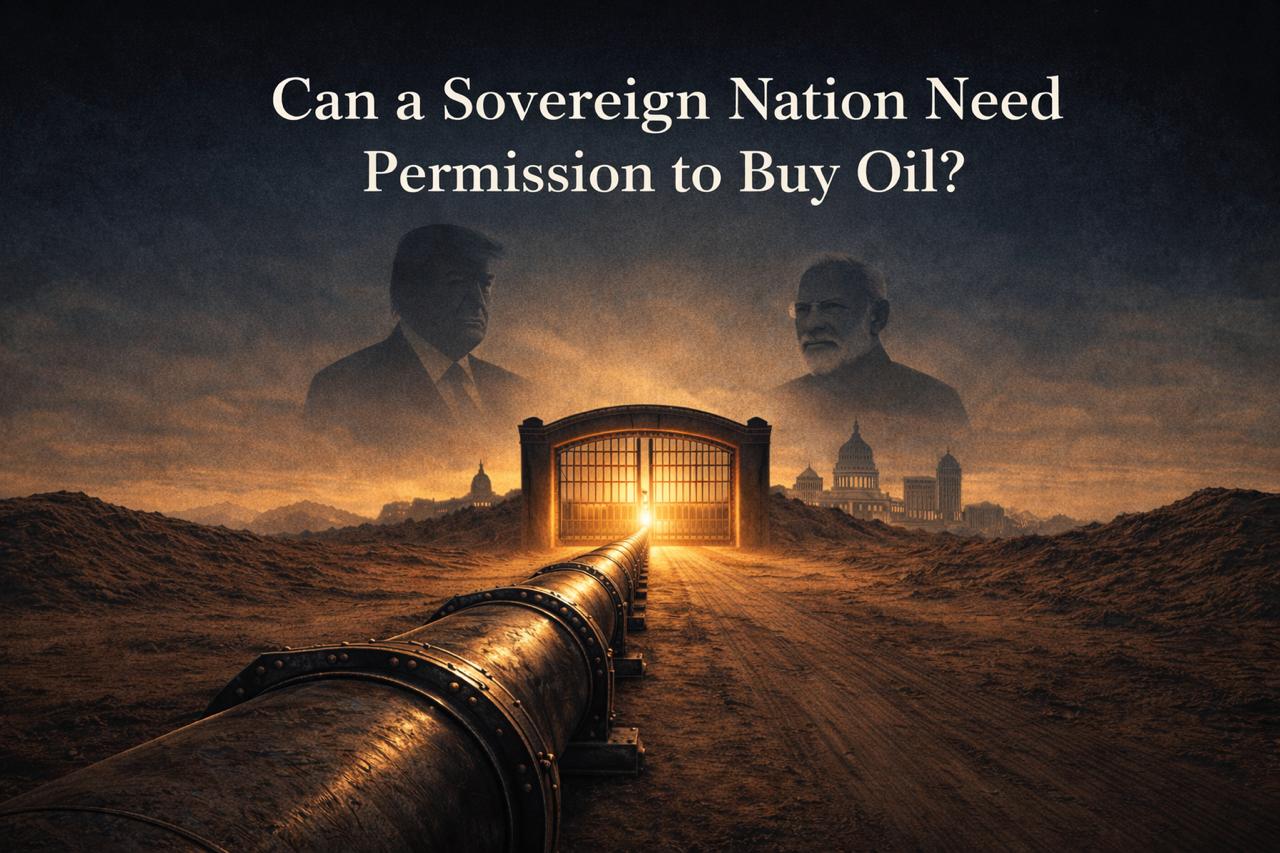
From Vishwaguru to the 56-inch image, the language of power has been grand. But if Washington can still “allow” India to buy Russian crude, the gap between performance and reality deserves closer scrutiny.
In politics, power is often performed before it is exercised.
That is why one word matters here more than all the diplomatic cushioning wrapped around it: allow.
If the United States can “allow” India to keep buying Russian oil for a defined period, then the issue is not merely technical. It is not just about sanctions paperwork or regulatory flexibility. It raises a more awkward question. What does sovereignty really mean if a country of India’s size must operate within limits set by another power to secure something as basic as energy?
The question is uncomfortable precisely because it cuts through the theatre.
For years, Indians have been told that this is an age of muscular national assertion. The imagery has been unmistakable. India, we hear, is no longer hesitant. It is decisive, respected, rising. The vocabulary of power has grown steadily larger, from civilisational grandeur to Vishwaguru flourishes to the old cult of the 56-inch chest. It is meant to project a state that bends to no one.
Yet geopolitics is indifferent to chest-thumping. It has a habit of exposing countries through their dependencies.
India is the world’s third-largest consumer of crude oil. Around 85 per cent of its oil requirement is imported. This is not a footnote. It is a structural fact.
That is why India increased purchases of discounted Russian crude after the Ukraine war disrupted global markets. The decision made sense. It helped cushion inflationary pressures and protected Indian consumers from the full force of a volatile oil market.
But national interest does not operate in a vacuum. It operates within systems. And those systems are not neutral.
Oil may be bought and sold across continents, but the trade rests on an invisible architecture of shipping routes, marine insurance, banking channels, compliance rules, and dollar-denominated settlements.
That is where the word “allow” begins to sting.
Because once Washington imposes sanctions, or signals the possibility of tighter enforcement, the effect goes well beyond American territory.
So yes, India may continue to buy oil. But if that continuation must be described as something another capital has permitted, then the boastful language of full-spectrum autonomy begins to sound rather hollow.
This is the contradiction at the centre of contemporary Indian foreign policy rhetoric.
And energy is only one part of the picture.
A significant share of India’s oil imports passes through the Strait of Hormuz, one of the world’s most fragile chokepoints.
New Delhi has not ignored these risks. It has diversified suppliers, expanded strategic reserves, and increased investment in renewable energy.
The phrase Vishwaguru was always more useful as domestic branding than as a description of material power.
And leverage is measured not in slogans, but in options.
The freedom movement imagined sovereignty as more than a transfer of authority.
India’s rise is real. Its ambitions are legitimate. But a serious country must be able to speak seriously about its limitations too.
What, after all, is the true size of a 56-inch claim if the nation behind it must still wait for someone else’s nod at the oil counter?
Author Bio: Shuja Gandhi is a socio-political thinker and public affairs commentator. He is a national coordinator of the Indian National Congress and writes on democracy, media and India’s strategic choices in a multipolar world. He is based in Champaran, Bihar.

Over the past 12 years, India seems to have drifted away from its sovereign strength, highlighting the serious shortcomings in Modi’s leadership.