
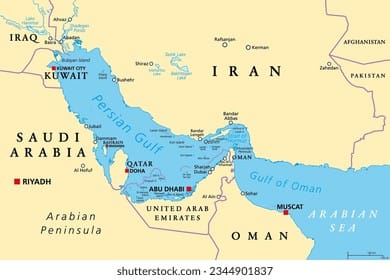
Iran is presently facing combined military action from Israel and the United States. The tension escalated in the region apparently to inflict sanctions on Iran’s nuclear program. On the first day of the attacks, Iran lost Ali Hosseini Khamenei, and the Iranian administration went into the control of the Islamic Revolutionary Guard Corps (IRGC). Amidst this tension, Iran also targeted US centres in the United Arab Emirates, Bahrain, Oman and other Gulf countries. Israel is also attacking Beirut citing an exercise to neutralise the Hezbollah Group. However, the situation further worsened with the sinking of Iris Dena in the Indian Ocean after being hit by an American torpedo. Currently, the situation is looking more Gulf centric, but it has significant implications on India.
Strait of Hormuz is a narrow passage acting as a conduit between the Gulf of Oman and the Persian Gulf. This passage is legally controlled by Iran and Oman. The Strait of Hormuz is a major trade route between the Arab world and the Indian Ocean and is responsible for one-fifth of crude oil trade in the world. It also gives access to India to Chabahar Port, its strategic base in Iran, that further opens the doors to Central Asia and Europe. If the present Gulf war continues, it will have an effect on major economies like India and China.
Presently, both India and China are heavily dependent on oil imports from the Arab world. If the Strait of Hormuz goes into the hands of a western administration, the entire oil sector will be controlled by them, resulting in high tariffs on oil trades and may choke the energy supply to India. The situation would be more critical for China, considering China is the biggest consumer of Iranian oil in the world. The present situation for India is grim, it is estimated that India only has 30 days oil reserve, and to maintain the global inflow of oil supply to India, the US has given 25 days time to India to buy oil from Russia.
Hormuz is not just important for oil trade, but it will have an impact on Indian goods going to Gulf countries. The United Arab Emirates alone contributes around 8 percent of global trade for India. Indian pharmaceuticals, chemical, textile and agriculture sectors are dependent on the demand from the Gulf countries, and if the current tension continues, it will impact Indian companies dealing in the Gulf.
India’s foreign policy has changed in the last decade. Once a close partner, Iran now seems to be no longer a strategic partner for India in world politics. Such a stand may also impact India’s relations with China and Russia, and show a drift towards the United States, especially after the announcement of the India–US trade deal. Under the deal, the United States expected India to stop buying Russian oil and trade according to their terms.
Thus, the crisis around the Strait of Hormuz is not limited to a regional conflict; it has the potential to reshape global politics. Control over this narrow passage means influence over energy supply, trade routes, and strategic alignments across Asia, Europe, and beyond. Any prolonged disruption will deepen divisions between western powers and regional actors, strengthen military blocs, and push major economies into difficult diplomatic positions. Energy security will become a central issue in international negotiations, and global markets will remain vulnerable to sudden shocks.
For India, the situation is a direct test of its present foreign policy. India has in recent years balanced relations between the United States, Russia, Iran and Gulf countries, while also managing its strategic competition and economic ties with China. A conflict in Hormuz would force India to protect its energy security, trade interests, and diaspora in the Gulf, without fully aligning with any single bloc. India’s current approach appears to be more US centric, but sustained pressure from global powers may narrow its room for foreign operations. The quad-bloc presently not showing any activity in global politics and India cannot afford to impact its relation with Russia and China. The way India responds silently to this crisis is showing that New Delhi is in a wait and watch situation to react.
