
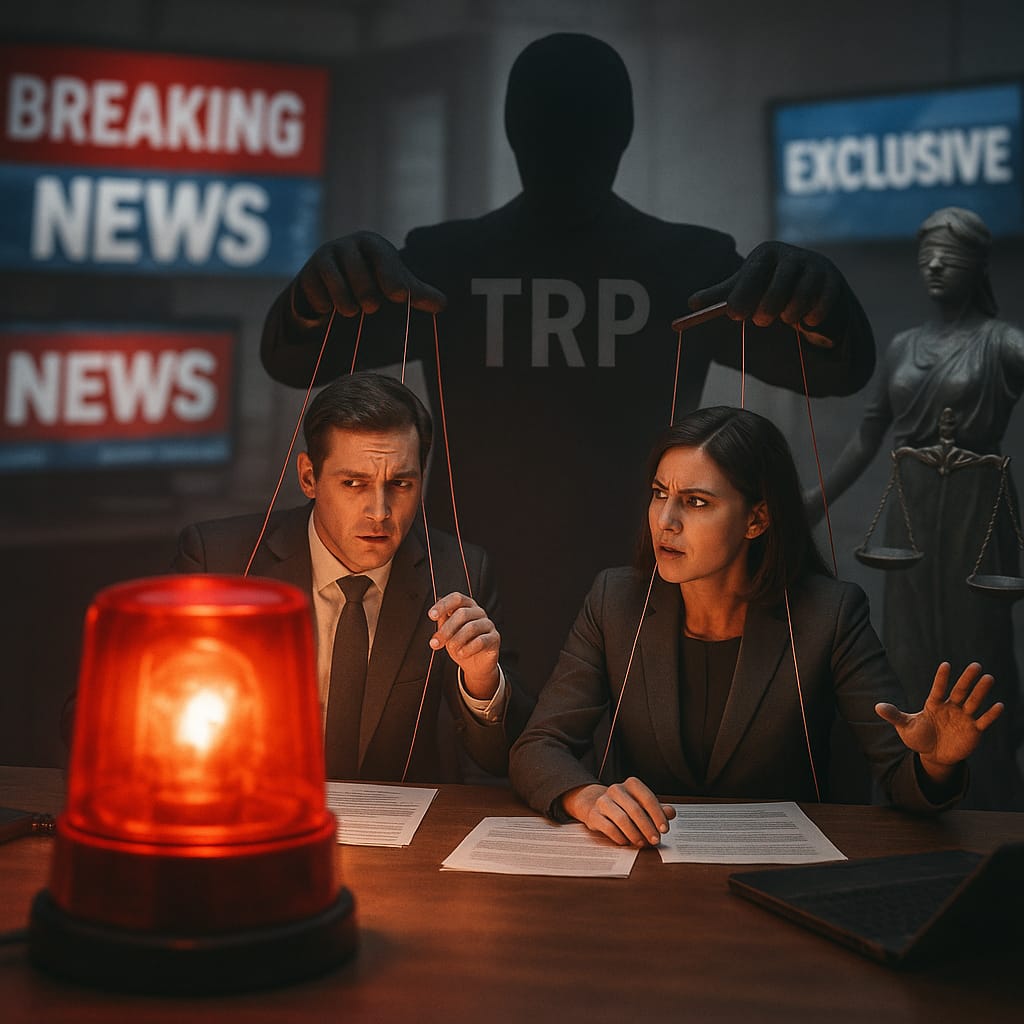
As tensions between India and Pakistan rose in recent weeks, what the public needed most was calm, credible, and verified information. Instead, what they received from many news channels was the exact opposite. In the rush to be “first,” not “factual,” several media outlets broadcast old footage from past military events, falsely labeling them as “live visuals.” Social media was flooded with unverified photos and dramatic hashtags. On primetime debates, anchors shouted over guests, trying to outdo each other in patriotic fury turning studios into battlefields.
Late at night, as the city lay silent and still. Television screens screamed with sirens, war like graphics, and chaotic headlines. “Breaking News” banners flashed every few seconds. In one such home, Mr. Dwivedi, a retired schoolteacher, sat alone, frozen in his chair, eyes fixed on the screen. By morning, his son found him disoriented, trembling, and deeply shaken. The cause was not real conflict. It was the terrifying theatre of a screen.
This story is not isolated. Across cities and towns, many families especially elderly citizens, people with anxiety issues, and children were impacted by what can only be described as psychological warfare disguised as news. People weren’t just watching the news; they were being overwhelmed by fear. What was broadcasted was not public service journalism. It was an unchecked wave of emotional manipulation. This kind of reporting is not just careless. It is dangerous.
When news stops being about facts and starts being about fear, the impact spreads far beyond the screen. Some senior citizens, already prone to heart issues, experienced panic attacks. Children, unable to process the chaos, clung to their parents with questions they couldn’t answer. People stayed awake all night, fearing an attack.
Let us not forget media is not entertainment. It is not theatre. It is a powerful institution, often called the Fourth Pillar of Democracy. Its responsibility is immense. At its best, journalism informs, educates, and unites. At its worst, it misleads, divides, and damages. The recent media conduct, during such a sensitive time, leans dangerously close to the latter.
There is no denying the right of the media to report. A free press is essential to any democracy. But freedom without accountability becomes recklessness. What we saw was not brave journalism it was noisy, shallow, and harmful. In pursuit of ratings (TRPs), clicks, and social media shares, the ethical lines of reporting were blurred. Viewers were treated not as citizens needing information, but as consumers of sensation.
Thankfully, steps have been taken. The Indian government, recognizing the potential threat posed by fake news during moments of national crisis, acted to ban certain digital platforms and accounts spreading misinformation. This is an important move. But it cannot stop here. Regulatory bodies such as the News Broadcasting and Digital Standards Authority (NBDSA) must strengthen their oversight. Repeat offenders must face consequences not just token warnings, but real penalties that act as deterrents.
At the same time, the public must be empowered with media literacy. We, as citizens, must learn to question what we watch, read, and share. Not every dramatic video is real. Not every forwarded message is true. The spread of fake news often relies not on technology, but on trust. And that trust is being misused.
This is not just about media. It’s about national responsibility. In a country as diverse and emotionally charged as India, irresponsible reporting can trigger unrest, panic, and even violence.
India deserves better. We deserve newsrooms that place truth above trend, facts above frenzy, and public interest above personal gain. We deserve anchors who lower their voices and raise the quality of discourse. We deserve media that heals, not harms.
To those who hold the camera, the microphone, and the pen your role is not entertainment. It is enlightenment. Millions trust you, depend on you, and believe in you. Do not betray that trust. Use your voice not to add to the noise, but to guide the nation through it.
This is not just a media crisis. This is a moment of moral reckoning.
